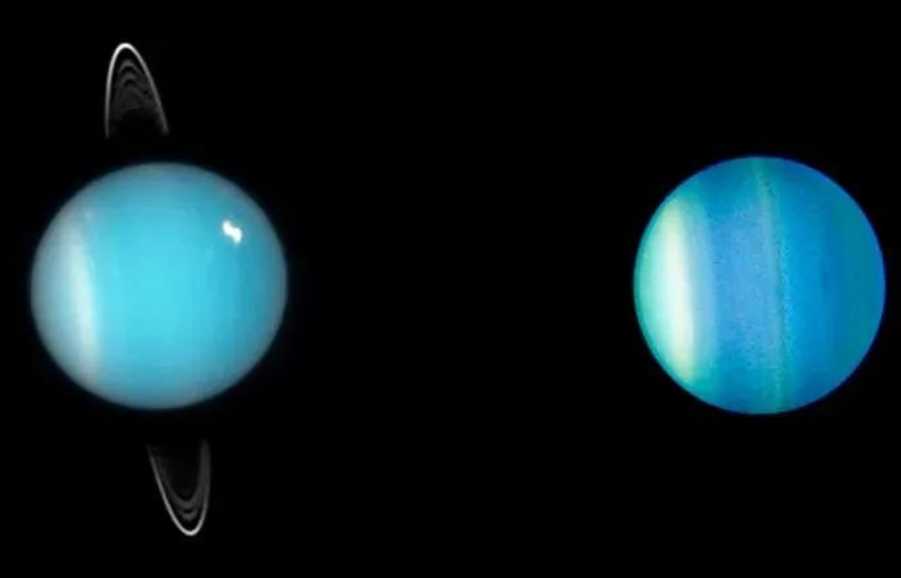
- Ice Giants: The Solar System’s Cold Titans
Uranus and Neptune (4–5 Earth radii) consist of ~80% "ice" (water, ammonia, methane) mixed with rock, topped by thin hydrogen-helium envelopes. Their distinctive blue hues stem from methane absorbing red light, but internal heat sources (Neptune’s is 2.6 times solar) and dynamic magnetospheres remain poorly understood.
- Mini-Neptunes: Bridging Planetary Types
These intermediate worlds (2–4 Earth radii) balance rocky cores with thick icy mantles and gaseous layers. Exoplanet surveys show they’re ubiquitous, but our solar system harbors none—unless distant trans-Neptunian objects like Eris hide unexpected secrets.
- Distance and Detection Challenges
Uranus and Neptune were visited only by Voyager 2 in 1986–1989; no dedicated missions since. Mini-Neptunes, if present, would lurk beyond Neptune or be masked by smaller icy bodies.
- Exoplanetary Insights vs. Solar System Gaps
Over 5,000 exoplanets include countless mini-Neptunes, but solar system studies focus on inner rocky planets and gas giants. This creates a critical knowledge gap: how did our system avoid forming mini-Neptunes, and what do their absence reveal about planetary evolution?
- Unlocking Cosmic Formation Clues
Ice giants’ formation theories—whether via core accretion or disk instability—hinge on better data. Mini-Neptunes, if found, could resolve debates about migration and atmospheric loss in our system’s history.
As missions like NASA’s Dragonfly (Titan) and ESA’s JUICE (Jupiter’s moons) take center stage, the ice giants and hypothetical mini-Neptunes wait in the solar system’s cold periphery—silent keys to understanding why our planetary neighborhood evolved so differently from the galaxy’s norm.